
Cashmere, honestly
Can You Wear Cashmere in Summer?
Yes — in cool air. Badly, in heat. Cashmere is a fine protein fibre that absorbs moisture vapour and gives it back, so it does not turn clammy the way a sealed synthetic does. What it cannot do is shed liquid sweat. The variable that decides whether a cashmere garment works in July is fabric weight, not the fibre — and the three sweaters on this site are winter weights. Air conditioning, aeroplanes, evenings and altitude are where they earn their place out of season.
Why cashmere works in cool air
Three properties do the work, and none of them is about being thick.
- It is very fine. At 12–16 micron, a gram of cashmere contains far more individual fibres than a gram of lambswool. More fibres means more surface, more crimp, and more still air held between them — and still air is what insulates. A thin cashmere fabric can therefore be warm without being heavy.
- It handles moisture vapour. Cashmere is keratin, the same protein as hair. It takes water vapour into the fibre itself and releases it as the air around it dries. That is why a cashmere sweater in an over-cooled office feels dry rather than swampy, and why a synthetic fleece in the same room does not.
- It does not prickle. Prickle is caused by fibre ends stiff enough to press back against the skin. Below roughly 30 micron, fibre ends bend instead. Cashmere at 12–16 micron is nowhere near the threshold, which is why you can wear it against bare skin at all.
Why it fails in real heat
The same properties reverse. Cashmere absorbs moisture into the fibre, which is excellent for vapour and poor for liquid: once you are actually sweating, the sweater takes it up, holds it, and dries slowly. Wet cashmere is heavy, and a heavy knit worn wet stretches — the shoulders drop and the body grows. That is one of the few ways to permanently change the shape of a good sweater in a single afternoon.
Linen and open-weave cotton do the opposite: they move liquid to the outside and let it evaporate, and they conduct heat away from the skin. In 32 °C sunshine they will beat cashmere every time, and no amount of fibre marketing changes it.
The honest line is this. Cashmere is a cool-weather fibre that behaves unusually well at the warm end of its range. It is not a hot-weather fibre that has been unfairly maligned.
The number that actually decides it
Whether a specific cashmere garment can be worn in summer is a question about fabric weight — grams per square metre — and secondarily about ply. A single-ply, low-GSM cashmere tee is a genuine warm-weather garment. A four-ply cable knit is not, and no fibre argument will make it one. The fibre is identical in both.
We have not published ours
| Fibre | 100% cashmere, Grade A |
|---|---|
| Fibre diameter | 12–16 micron |
| Fabric weight (GSM) | To be confirmed from the workshop |
| Ply | To be confirmed from the workshop |
| Garment weight (g) | To be confirmed from the workshop |
Which means we cannot tell you, with a number, how well any of these three works in warm weather — and we are not going to estimate one on a page whose whole argument is that the number is what matters.
Six places it earns its keep in summer
All of these are cool air inside a warm season, which is the actual use case.
- An air-conditioned office. The most common one by a distance. Buildings cooled for a crowd are cold for an individual sitting still.
- Aeroplanes. Cabin air is cold and very dry; a fibre that manages vapour is worth more there than at sea level.
- Summer evenings. The temperature drop after sunset is what a lightweight sweater is for — something you can carry all day and not resent.
- Altitude. Anywhere in the mountains in August is cold at night. The fibre in these sweaters comes from above 3,000 metres for exactly that reason.
- Coastal fog and wind. A July evening on a cold-current coast is not a July evening.
- Restaurants, cinemas, trains. Anywhere the thermostat is set by someone else.
The pattern is that a summer cashmere sweater is a carried garment, not a worn one. It spends most of the day over an arm or in a bag. That is worth knowing before you buy, because it changes what matters: low weight and a fabric that does not crease into a ruin become more important than warmth.
What our three sweaters are, in the catalogue’s own words
The workshop describes the crew neck as lightweight for warmth and the V-neck as thin cashmere, lightweight, perfect for winter. That last phrase is the catalogue’s, not ours, and we are leaving it in: these are winter sweaters that happen to be thin, and the sentence says so.
If you are buying one with warm-weather wear in mind, the Men's V-Neck Cashmere Sweater is the one the catalogue itself calls thin. The open collar helps too — a V releases heat at the neck in a way a closed crew does not, and the neck is where you notice being too warm first. It is 13 colourways, S–2XL, $155.
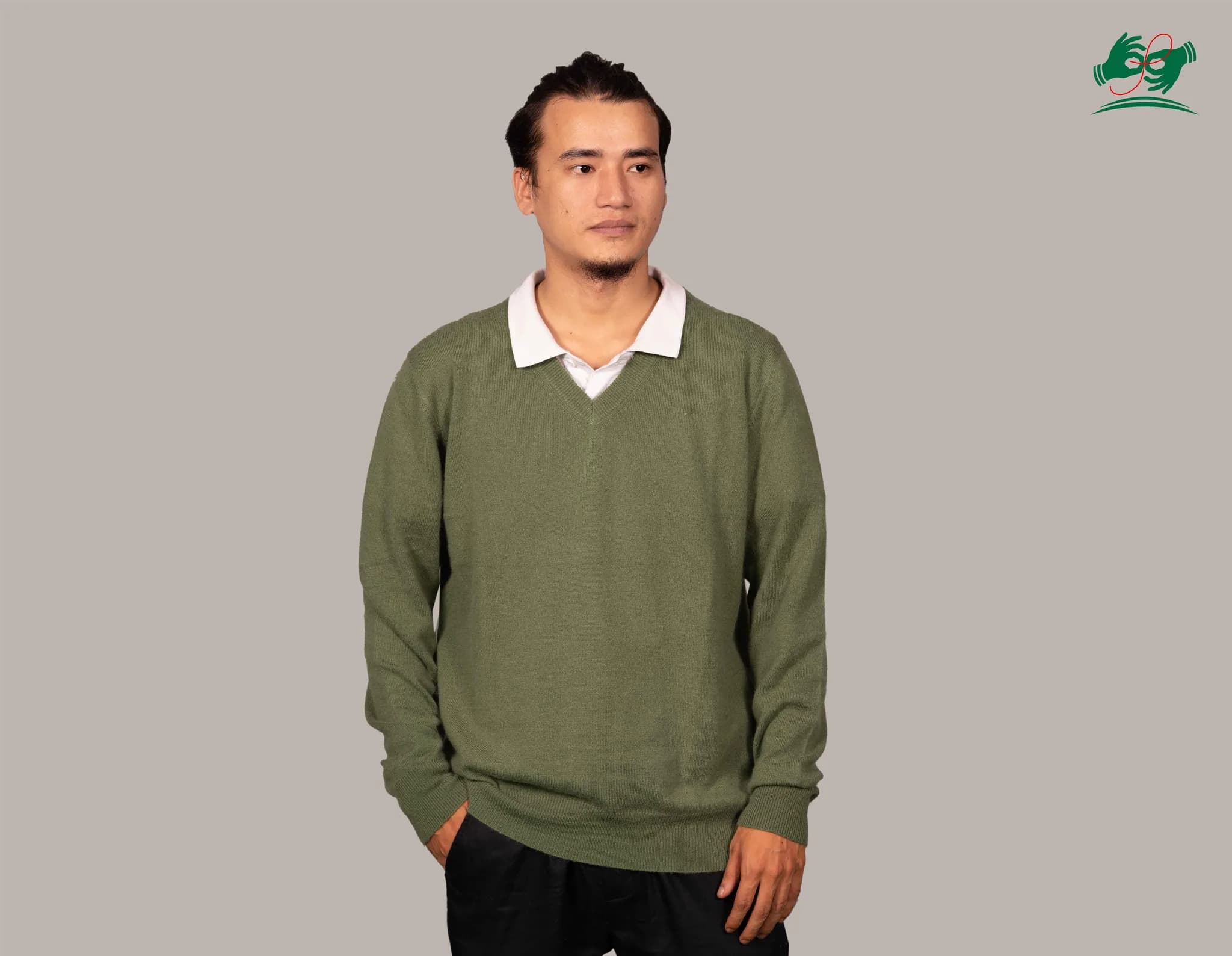
The sweater in that photograph is the Olive, and colour is worth a sentence here because a dark, saturated knit reads as winter clothing whatever it weighs. Olive is the one green we make and it is desaturated enough to pass as a neutral — Green Cashmere Sweaters for Men. The other shade that does not announce the season is the dusty Sky Blue on Blue Cashmere Sweaters for Men, where the same page also carries the Indigo, which very much does.
The Men's Crew Neck Cashmere Sweater is the same weight in a closed collar — better in genuine cold, warmer than you want on a mild day. The Men's Quarter Zip Cashmere Sweater is the most adjustable of the three, because an open zip vents the neck and a closed one seals it, but it is free size only — 65 cm long, 50 cm across the chest, 60 cm sleeve — so it fits whoever it fits.
Wearing it in warm weather without ruining it
- Put something thin underneath. Not for warmth — to keep skin oils and sweat out of the cashmere, which is what forces the wash cycle. A fine cotton or merino tee is enough. Full detail on What to Wear Under a Sweater.
- Sleeves down, not pushed up. Pushing sleeves up in the heat is the fastest way to bag out a cuff, and the forearm is already one of the first places cashmere pills.
- Do not wear it two days running. Fibres need a day to recover their loft, and recovered fibre resists tangling. In summer this matters more, not less.
- Air it rather than washing it, when you can. A night on a flat surface in moving air handles most of what a summer day does to a sweater.
- When you do wash it: by hand, maximum 30 °C, gentle wool detergent, no wringing, reshape damp, lay flat out of direct sun. Not the machine.
Warm-weather wear also means more friction against bare or lightly covered skin, which means more pilling early on. That is normal and it settles — Does Cashmere Pill? explains why, and how to take pills off without cutting the fibre.
Storing it through the months you do not
Half of the summer cashmere question is really about the sweaters you are not wearing. Clothes-moth larvae eat keratin, and they go for fibre carrying skin oils, food and sweat. A sweater put away dirty in May is the one with holes in October.
- Wash it before storage, not after. This is the whole game.
- Dry it completely. Flat, out of sun, until there is no damp in the seams.
- Fold, never hang. A season on a hanger stretches the shoulder permanently.
- Seal it. A closed box or a zipped bag beats an open shelf. Cedar and lavender are pleasant; a sealed container is what actually works.
- Check it once mid-summer. Damage found in July is a wash; damage found in October is a repair.
The out-of-season argument nobody makes
Cashmere is bought in a panic in December and chosen carefully in June. If you are reading this in spring, you are in the better position: you can measure a sweater you already own, compare it against a published chart, wait for the colourway you want, and absorb the fact that these ship from Pokhara, Nepal — which is slower than a domestic order and is the single most common complaint in this whole category when people order in December.
So: yes, you can wear cashmere in summer, in the specific conditions above, and the sweater will be better for having been chosen out of season. The full range is on Men's Cashmere Sweaters; the thin one is the Men's V-Neck Cashmere Sweater at $155. If you want the fibre story behind the weight, that is Himalayan Cashmere Sweaters, Made in Pokhara.
Common questions
Can you wear cashmere in summer?
Yes, in cool air — an air-conditioned office, an aeroplane, a summer evening, anywhere at altitude. In actual heat it is a poor choice, because cashmere holds moisture and dries slowly. The fibre is not the problem; the weight of the fabric is.
Is cashmere hot to wear?
Cashmere is warm for its weight rather than warm in absolute terms. A thin cashmere sweater is roughly as warm as a thicker garment in a coarser fibre, which is why it works in cool air without bulk. Stack it under a jacket in July and it will be too warm, exactly like anything else would be.
Does cashmere breathe?
Yes. Cashmere is a protein fibre and absorbs moisture vapour into the fibre itself, then releases it, so it does not go clammy the way a sealed synthetic does. What it does badly is shed liquid sweat — once it is properly wet it stays wet, and wet cashmere is heavy and stretches while you wear it.
Can you wear a cashmere sweater with nothing underneath?
You can, and at 12–16 micron it will not prickle. The cost is laundry: skin oils and sweat go straight into the fibre, so the sweater needs washing more often, and every wash is a hand wash at a maximum of 30 °C. In summer, a thin layer underneath is mostly a way of washing the sweater less.
How should I store cashmere over the summer?
Wash it before it goes away, not after it comes back. Clothes-moth larvae eat keratin and are drawn to soiled fibre, so a clean sweater in a sealed box is far safer than a worn one in an open drawer. Fold, never hang — a hanger stretches the shoulder over a whole season.