
Layering, measured
How to Wear a Sport Coat with a Sweater
Use a fine-gauge crew neck. Its closed collar sits flat inside the lapels and gives you one unbroken line from shoulder to button, which is what a sport coat wants. The whole thing succeeds or fails on thickness: a sport coat’s chest and armhole were cut with ease for a shirt, not a knit. A thin sweater fits inside that allowance. A chunky one pulls the jacket into an X at the button and there is no fixing it from the outside.
Why the crew neck is the default
A sport coat frames a triangle between the lapels. Whatever fills that triangle is the outfit. There are three realistic candidates and they behave differently:
| Under the lapels | How it reads |
|---|---|
| Crew neck | Solid colour, clean horizontal at the throat, no shirt required. The most forgiving option and the one that still works when you take the jacket off. |
| V-neck | Leaves an open wedge that has to be filled by a shirt collar. Excellent with one, unfinished without one. |
| Funnel neck / quarter zip | Sits high on the throat and occupies the space the lapel roll wants. Works as a deliberate sporty look, fights the jacket in a formal one. |
A crew neck cashmere sweater is the version of this that adds the least bulk for the warmth, which matters because bulk is the whole constraint. Fine fibre at 12–16 micron packs more insulating air into less thickness than a coarser wool at the same warmth. That is the practical reason cashmere ended up as the standard knit to wear under tailoring rather than a luxury affectation.
Three measurements decide whether it works
You can settle this with a tape measure on a flat table in about four minutes, which is more use than any amount of styling advice. Lay both garments flat and measure the same way on each.
| Size | Body length · Chest, flat · Sleeve from shoulder seam |
|---|---|
| S | 64 · 48 · 60 cm |
| M | 66 · 50 · 62 cm |
| L | 68 · 52 · 64 cm |
| XL | 70 · 54 · 66 cm |
| 2XL | 73 · 56 · 68 cm |
- Chest. Ours measure 48–56 cm flat, so 96–112 cm around. Compare that against your jacket’s chest measured the same way. If the jacket is not comfortably larger, it will not close over the knit without strain — and strain shows as diagonal creases radiating from the button.
- Body length. Ours run 64–73 cm from the shoulder. If the sweater is longer than the jacket, its hem will show below the jacket hem, which reads as an accident rather than a choice.
- Sleeve. Ours run 60–68 cm from the shoulder seam. This is the one that catches people out, and it gets its own section.
If you are between sizes and buying specifically to wear under tailoring, take the smaller — the opposite of the usual advice. Under a jacket you want the knit close to the body, because every extra centimetre of circumference has to go somewhere and the jacket has nowhere to put it. Full measurements are on the Men's Cashmere Sweater Size Guide & Fit.
The sleeve, where it usually goes wrong
A jacket sleeve is cut short on purpose so that a shirt cuff shows at the wrist. A sweater sleeve is cut to reach the wrist bone. Put one inside the other and the knit cuff can end up level with, or past, the jacket sleeve — and a knit cuff poking out where a shirt cuff should be is the detail that makes the whole outfit look improvised.
Measure both from the shoulder seam to the cuff edge. If the sweater sleeve is longer than the jacket sleeve, you have three options: size down the sweater, push nothing and accept the knit cuff as the look, or wear a shirt and let the shirt cuff do the job while the sweater sleeve sits shorter inside. Do not solve it by pushing the sweater sleeve up — that bags the cuff permanently and the forearm is already one of the first places a knit pills.
Shirt, tee, or nothing under the sweater
Under a sport coat, a crew neck on bare skin is a complete outfit and always has been. Adding a shirt buys you two things: a collar at the throat and a cuff at the wrist. If you do not want either of those visible, the shirt is doing nothing but adding a layer.
- Nothing. Cleanest. Requires a fine sweater — at 12–16 micron there is no prickle — and costs you laundry, because the knit takes up skin oils directly.
- A thin tee. Invisible, and it halves how often the sweater needs a hand wash at 30 °C. The default for most people most days.
- A collared shirt. Use a button-down or a spread with stays in. A soft collar collapses under the weight of the knit, and under a jacket it has even less room to recover.
The full breakdown of that decision, including which collars survive and what colour to put under pale knits, is on What to Wear Under a Sweater.
Pairing the colour and the texture
A sport coat is usually the textured, patterned piece — tweed, houndstooth, corduroy, a check. That does two things to your sweater choice: it argues for a plain knit, and it argues for a clear step in value between the two so they do not blur into one another.
- Brown or grey tweed: Charcoal Black
#3b3132or Graphite#34343cunderneath, so the jacket’s pattern stays the event. Olive#66694eif you want the outfit to be about the colour — it is the only green we make, and it is on Green Cashmere Sweaters for Men. - Navy or dark solid: Oat
#d0b7acor Sand#e8ba91— light against dark is the easiest contrast to get right, and it lifts the whole thing at eye level. Both sit in the four-shade tan family on Brown Cashmere Sweaters for Men, which is where to compare them side by side before choosing. - Light or summer-weight coat: Yale Blue
#2e3758or Indigo#023f92for a deliberate colour, Ash Grey#9b8991for a quiet one. Indigo is a royal blue rather than a navy, and the difference between it and the dusty Sky Blue is the whole argument of Blue Cashmere Sweaters for Men. A winter-weight knit under a summer jacket is its own question — Can You Wear Cashmere in Summer? - Avoid: a knit within a shade of the jacket. Near-matches read as a failed attempt at matching; a real gap reads as a decision.
Hex values are the workshop’s own dye-lot codes. Small-batch dyeing varies between lots, and screens vary more, so treat them as a guide to the family rather than a colour match.
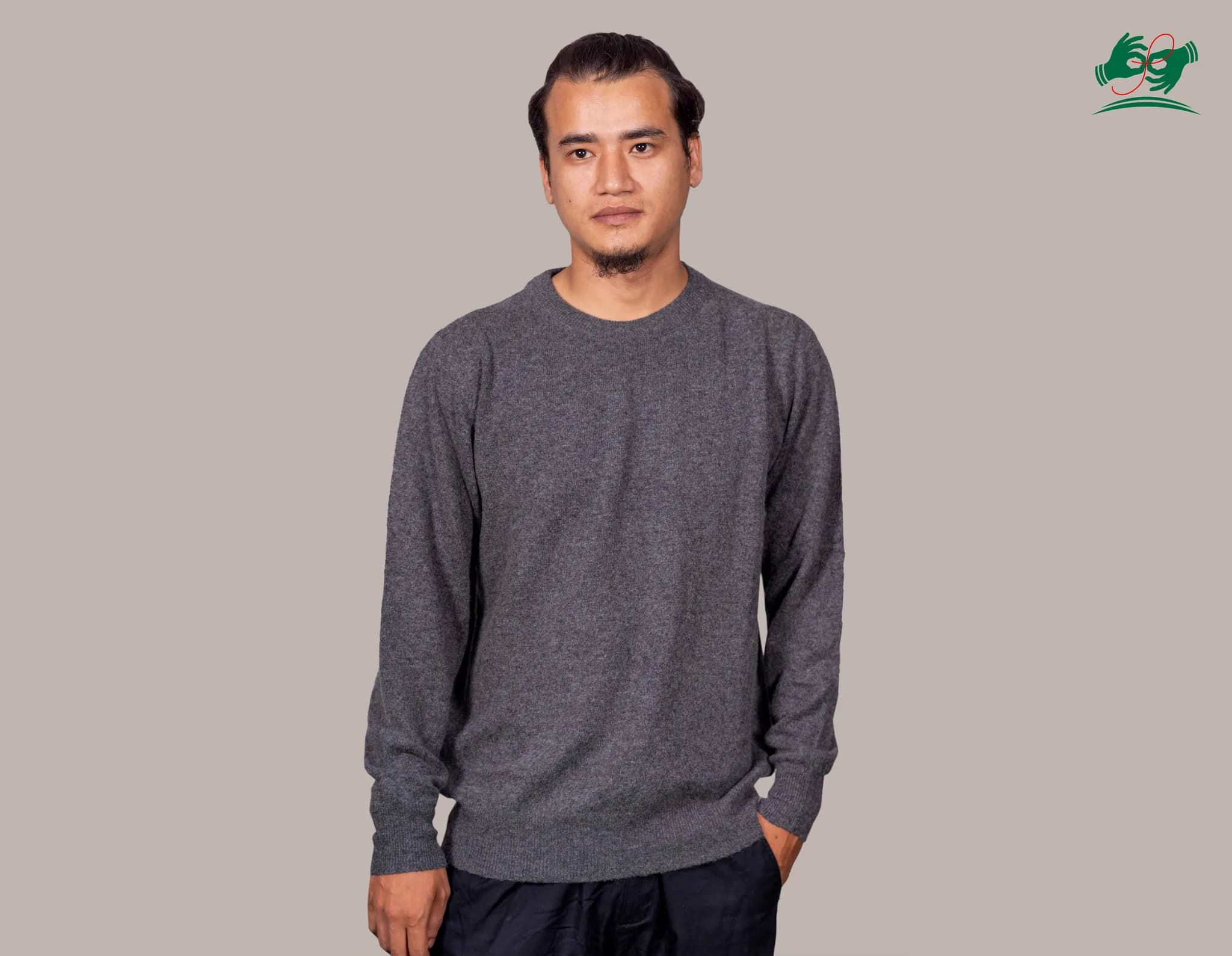
Five ways this goes wrong
- The X at the button. Diagonal creases pulling from the fastened button mean the jacket is closed over more bulk than it was cut for. Either wear it open or wear a thinner knit.
- A knit cuff past the jacket sleeve. Covered above. Measure first.
- A cable or chunky knit. The texture fights a textured jacket and the thickness fights the armhole. Save it for a coat.
- A collapsed shirt collar. Structure or nothing.
- An oversized sweater. Excess fabric at the waist has to fold, and under a jacket it folds visibly at the sides. This is the one case where sizing up is wrong.
The sweater to buy for it
If you are buying one knit to wear under tailoring, buy a plain crew neck cashmere sweater in a dark neutral. It works under a sport coat, under a blazer, under a coat, and on its own when the jacket comes off. A V-neck does the tailoring job well only when a shirt is filling it; a quarter zip is a different look entirely.
Ours is the Men's Crew Neck Cashmere Sweater — $155, 14 colourways, S–2XL, 100% Grade A Himalayan cashmere at 12–16 micron, knitted in Pokhara, Nepal. Charcoal Black, Graphite and Ash Grey are the three that do the most work under a jacket.
If you wear a shirt and tie under the knit rather than a bare crew, the Men's V-Neck Cashmere Sweater is the correct collar for that and is covered on Wearing a Sweater Under a Blazer (and Suit). And if you would rather the jacket came off entirely, the Men's Quarter Zip Cashmere Sweater is $120 — one colour, free size only at 65 · 50 · 60 cm.
Two things we cannot tell you yet
| Fabric weight (GSM) | To be confirmed from the workshop |
|---|---|
| Ply | To be confirmed from the workshop |
Gauge and ply are exactly the numbers that would settle “is this thin enough to go under my jacket” without a tape measure. We have not published them, because we have not measured them. Until then, the chest and sleeve figures above are the honest way to check.
Common questions
Can you wear a sweater under a sport coat?
Yes, and it is one of the few ways to dress a sport coat down without it looking like an orphaned suit jacket. The constraint is thickness: a sport coat's chest and armhole were cut with ease for a shirt, not a knit. A fine sweater fits inside that allowance. A chunky one does not, and the jacket will pull into an X at the button.
What kind of sweater goes under a sport coat?
A crew neck, in a fine gauge, in a plain colour. The crew's closed collar sits flat inside the jacket's lapels and gives you an unbroken line from the shoulder to the button. A V-neck leaves a gap that needs a shirt to fill it, and a funnel or zip neck competes with the lapel for the same space.
Should you wear a shirt under a sweater with a sport coat?
Only if you want the collar or the cuff to show. A crew neck sweater worn on its own under a sport coat is a complete outfit. If you add a shirt, use a collar with structure — a button-down or a spread with stays — because a soft collar collapses under the weight of the knit.
What colour sweater goes with a sport coat?
Something a clear step darker or lighter than the jacket, so the two read as separate layers rather than a failed match. A charcoal or graphite knit under a mid-grey or brown tweed works; an oat or sand knit under navy works. The riskiest pairing is a sweater in almost the same colour as the jacket but not quite.
What is the difference between a sport coat and a blazer?
A sport coat is the odd jacket — patterned or textured, tweed, houndstooth, corduroy — worn with trousers it does not match. A blazer is plainer and more formal, usually solid navy. A sweater works under both, but the blazer is the one that also has to accommodate a shirt and often a tie, which changes which neckline you want.